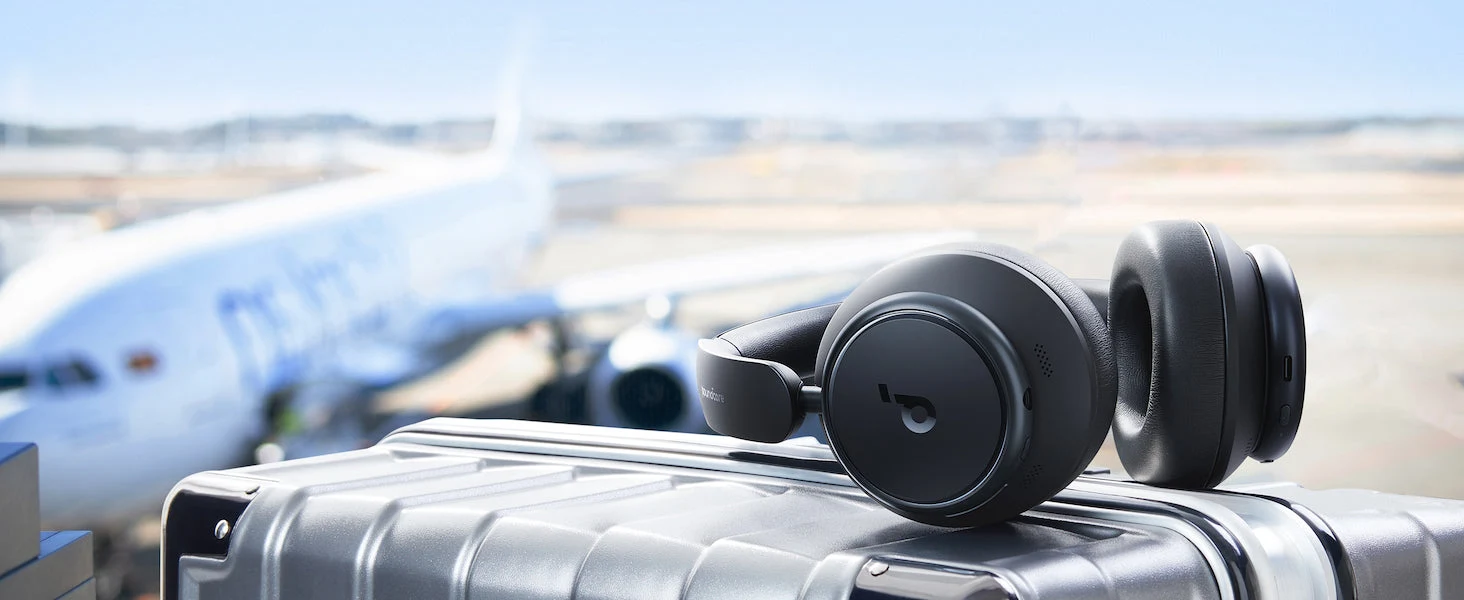
The Q45 has a long manufacturer-rated listening duration, but travel suitability also depends on fit, storage and compatible sources. Do not treat a maximum as a measured trip guarantee.
Manufacturer information informs the product details; the buying analysis is our own. This is not a hands-on test.The details at a glance
- Published ANC playback
- Up to 50 hours
- Published standard playback
- Up to 65 hours
- Published test condition
- Manufacturer FAQ specifies 60% volume
A journey is longer than a flight
Travel listening can begin on a bus to the airport and continue through a lounge, flight and hotel work session. Add those periods before deciding what battery margin you need. A short flight is not the only relevant interval. Equally, a long advertised battery life is less valuable if your main concern is comfort through an ordinary two-hour journey.
The Q45 manufacturer FAQ lists up to 50 hours with noise cancellation on and 65 hours off at its stated volume condition. Calls and other operating conditions can reduce duration. These are useful planning references, not independent measurements. Keep the supported mode and test conditions attached to the number rather than presenting all listening as identical.
Plan where charging will actually happen. A known hotel socket or a compatible charger in a bag is more dependable than assuming every seat has a working outlet. Do not wait until the headphones are nearly empty to learn their charging requirements. A modest charging routine can matter more than extracting the last theoretical hour.
Noise control should follow the place
A flight cabin, airport announcement area and quiet room ask different questions. Adaptive cancellation can be useful for reducing distraction, while ambient modes are intended for other situations. None is a safety guarantee. When you need to hear instructions clearly, stop playback or remove the headphones rather than assuming a setting will relay everything important.
Compare controls for the situations where you will change them. A familiar physical button can be easier to operate while carrying bags than an app screen. Review the exact control mapping and any available customization. The most practical interface is the one you can operate deliberately, not necessarily the one with the most possible settings.
Avoid judging cancellation from a promotional image of a silent-looking cabin. We have not conducted an acoustic test. Your result will depend on fit, the noise and your expectations. The reason to shortlist a model is that it offers the relevant documented controls, followed by a suitable opportunity to assess the actual experience.
Pack the arrangement, not just the headphones
Consider the case, charging cable and any audio connection you intend to use. A folding design can help with storage, but the total bag space depends on the case and accessories. Verify the contents of your selected package. A product shot that includes multiple items does not establish that every seller’s offer contains all of them.
If seatback audio matters, check the required connection and the supported wired mode. Airline equipment varies, so do not assume one cable or adapter fits every journey. Confirm microphone and noise-control behaviour for the mode you intend to use. Wired and wireless operation are related experiences, not necessarily identical feature sets.
Keep the headphones protected rather than loose among sharp or heavy objects. Check cleaning and storage guidance, especially after a warm journey. Comfortable earcups are worth preserving. A travel appliance that survives repeated packing and can be serviced sensibly is more useful than a pristine specification sheet with no plan for carrying it.
Choose for the person wearing them
Long-duration comfort cannot be inferred from long-duration battery life. Glasses, clamping pressure and heat can matter more during extended wear than on a quick shop demonstration. Build in breaks and consider a trial or appropriate return arrangement. More battery is not an obligation to keep wearing headphones continuously.
Check phone and laptop compatibility before enabling advanced modes. Codec support, app settings and concurrent-device behaviour need to match the devices you travel with. If calls are central, evaluate them on those devices. A music-focused feature list does not prove that your conferencing application will choose the correct microphone automatically.
The Q45 makes sense to investigate when you want a travel-oriented combination of noise control and substantial rated battery duration. It is not a shortcut around fit and compatibility. Buy a complete routine that you can pack, operate and recharge comfortably, rather than treating the largest hour figure as the entire buying decision.